基于STM32单片机的的语音控制小车系统设计与实现
摘 要
近年来,随着经济和物质生活水平的提高,电子产品的充分使用已成为人们对优质生活品质的一种衡量标准。这种情况也存在于玩具市场上,智能化玩具不仅受孩子们的喜爱,而且还能开发孩子们的智力水平。玩具智能化已经成为现在的一种发展趋势。所以本设计开始研发一款基于STM32的语音控制四轮小车。
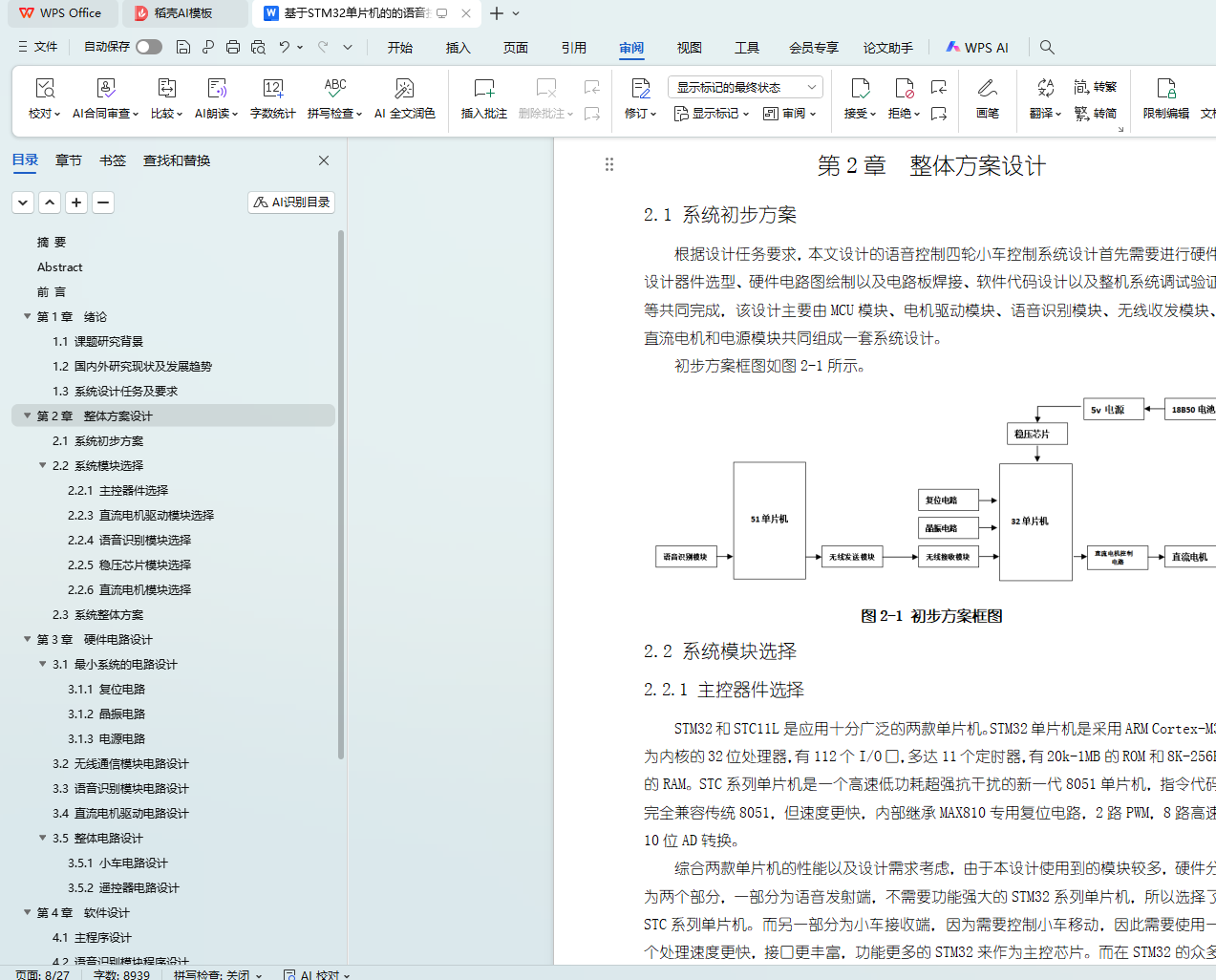
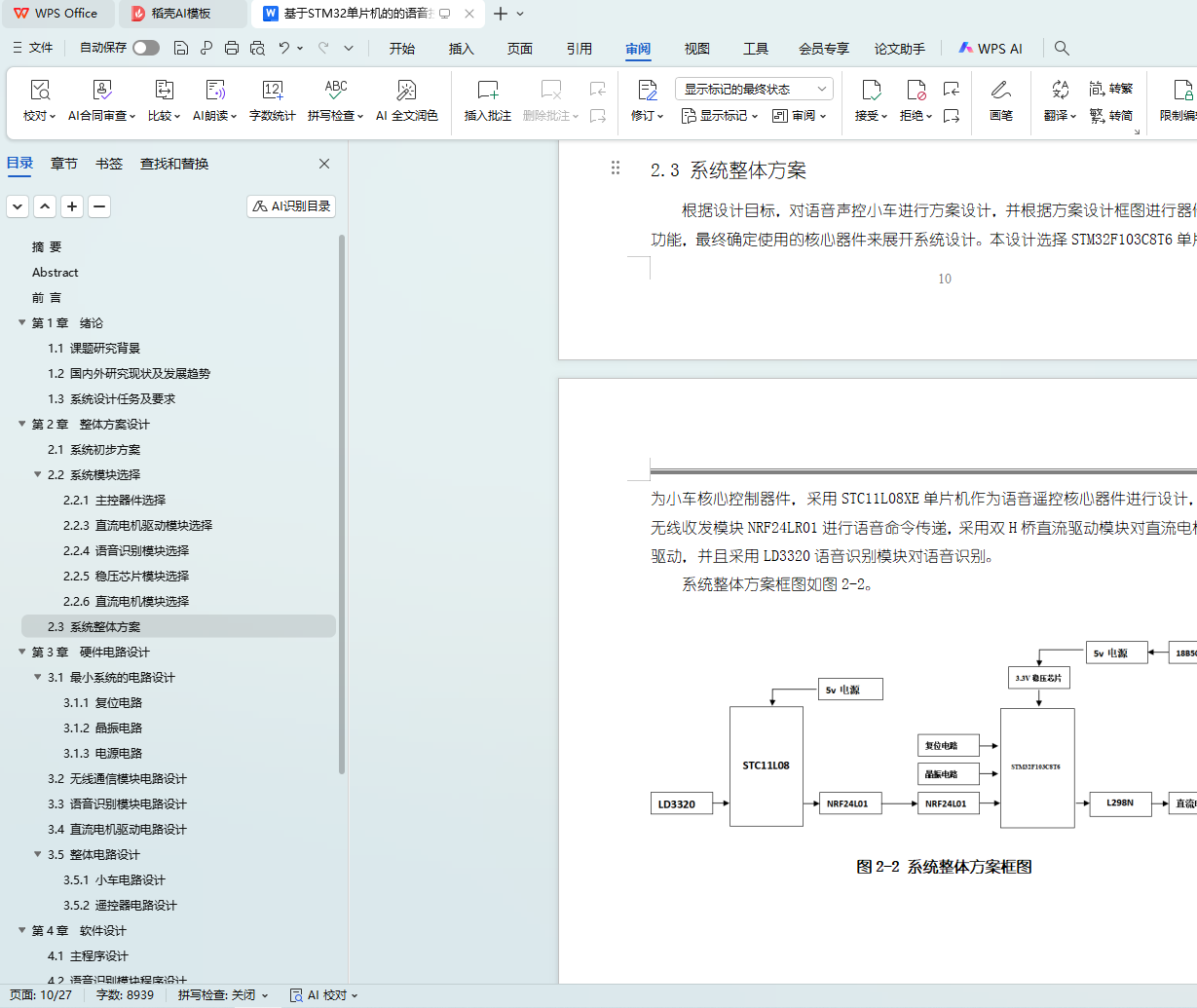
本设计分为小车驱动模块和语音遥控器两个主要部分。其中语音遥控器采用51单片机为核心器件,通过LD3320语音识别模块进行声音采集,小车驱动模块采用32单片机通过无线模块NRF24L01接收命令将控制命令传输到小车驱动控制端,通过控制L298N直流电机控制模块来调整小车行驶方向。这样设计使得小车控制更加灵活,不像遥控小车那样操作频繁使得人们疲劳。也为智能小车玩具行业增加一种新的产品,具有一定的市场优势。
关键词:STM32;智能小车;无线传输;LD3320语音模块
Abstract
In recent years, with the improvement of economic and material living standards, the extensive use of electronic products has become a benchmark for measuring high-quality living standards. This trend is also evident in the toy market, where smart toys are not only beloved by children but also enhance their cognitive development. Intelligent toys have emerged as a prevailing industry trend. Consequently, this project focuses on developing a voice-controlled four-wheeled vehicle based on the STM32 microcontroller.
This design consists of two main components: a vehicle drive module and a voice remote controller. The voice remote controller employs a 51 microcontroller as its core component, utilizing the LD3320 voice recognition module for sound acquisition. The vehicle drive module utilizes a 32 microcontroller that receives commands via the NRF24L01 wireless module and transmits them to the drive control unit, which then adjusts the vehicle's direction through the L298N DC motor control module. This design enhances operational flexibility, reducing the frequent manual adjustments associated with traditional remote-controlled vehicles and minimizing user fatigue. It also introduces a new product to the smart vehicle toy market, offering distinct competitive advantages.
Keywords: STM32; smart cart; wireless transmission; LD3320 voice module
目录
摘 要
前 言
第1章 绪论
1.1 课题研究背景
1.2 国内外研究现状及发展趋势
1.3 系统设计任务及要求
第2章 整体方案设计
2.1 系统初步方案
2.2 系统模块选择
2.2.1 主控器件选择
2.2.2 无线通信器件选择
2.2.3 直流电机驱动模块选择
2.2.4 语音识别模块选择
2.2.5 稳压芯片模块选择
2.2.6 直流电机模块选择
2.3 系统整体方案
第3章 硬件电路设计
3.1 最小系统的电路设计
3.1.1 复位电路
3.1.2 晶振电路
3.1.3 电源电路
3.2 无线通信模块电路设计
3.3 语音识别模块电路设计
3.4 直流电机驱动电路设计
3.5 整体电路设计
3.5.1 小车电路设计
3.5.2 遥控器电路设计
第4章 软件设计
4.1 主程序设计
4.2 语音识别模块程序设计
4.3 无线模块程序设计
第5章 实物与调试
5.1 实物
5.2 调试
5.2.1 软件测试
5.3 硬件测试
5.4调试过程遇到的问题
结 论
参考文献
附录1 电原理图