基于DDS技术的多功能信号发生器设计
摘要
本设计提出了一种基于STC89C52单片机和DDS专用芯片AD9850的多功能信号发生器方案。该信号发生器能够产生频率、幅度可调的正弦波、方波及三角波,并具备AM调幅、FM调频功能。系统采用直接数字频率合成(DDS)技术,通过单片机控制AD9850芯片实现波形的精确输出;利用高带DA转换器AD7524实现信号的程控衰减;采用模拟乘法器AD835完成AM调制,利用CD4046B锁相环芯片实现FM调制;控制端采用红外遥控方式,显示端采用LCD液晶显示屏,可实时显示输出信号的类型、频率、幅度等参数。经过理论分析、电路设计与系统调试,测试结果表明:输出信号频率范围满足设计要求,幅度调节范围达到预期指标,波形质量良好,系统运行稳定可靠,具有结构简单、控制精度高、操作方便等优点。
关键词: 信号发生器;DDS;AD9850;AM调制;FM调制;STC89C52
Abstract
This design proposes a multi-functional signal generator based on STC89C52 microcontroller and the dedicated DDS chip AD9850. The signal generator is capable of producing sine waves, square waves, and triangular waves with adjustable frequency and amplitude, and it also features AM amplitude modulation and FM frequency modulation functions. The system adopts Direct Digital Synthesis (DDS) technology, where the microcontroller controls the AD9850 chip to achieve precise waveform output. The high-speed DA converter AD7524 is used to implement programmable signal attenuation. The analog multiplier AD835 is employed to accomplish AM modulation, while the CD4046B phase-locked loop chip is utilized to achieve FM modulation. Infrared remote control is adopted at the control terminal, and an LCD display is used at the output end to show real-time parameters including signal type, frequency, and amplitude. After theoretical analysis, circuit design, and system debugging, the test results show that the output signal frequency range meets the design requirements, the amplitude adjustment range achieves the expected specifications, the waveform quality is good, and the system operates stably and reliably. The design features simple structure, high control accuracy, and convenient operation.
Keywords: Signal Generator; DDS; AD9850; AM Modulation; FM Modulation; STC89C52
目录
信号发生器
一、方案设计与论证
1、信号发生部分
2、信号放大部分
3、模拟FM电路的设计
4、输入控制部分
5、显示部分
二、理论分析、计算与各模块设计
(1)DDS波形产生电路设计
输出信号频率、参考时钟、频率控制码之间的关系
(2)程控衰减电路设计
(3)模拟AM电路设计
(4)模拟FM电路的设计
(5)控制与显示电路
三、电路与程序设计
1、总体电路
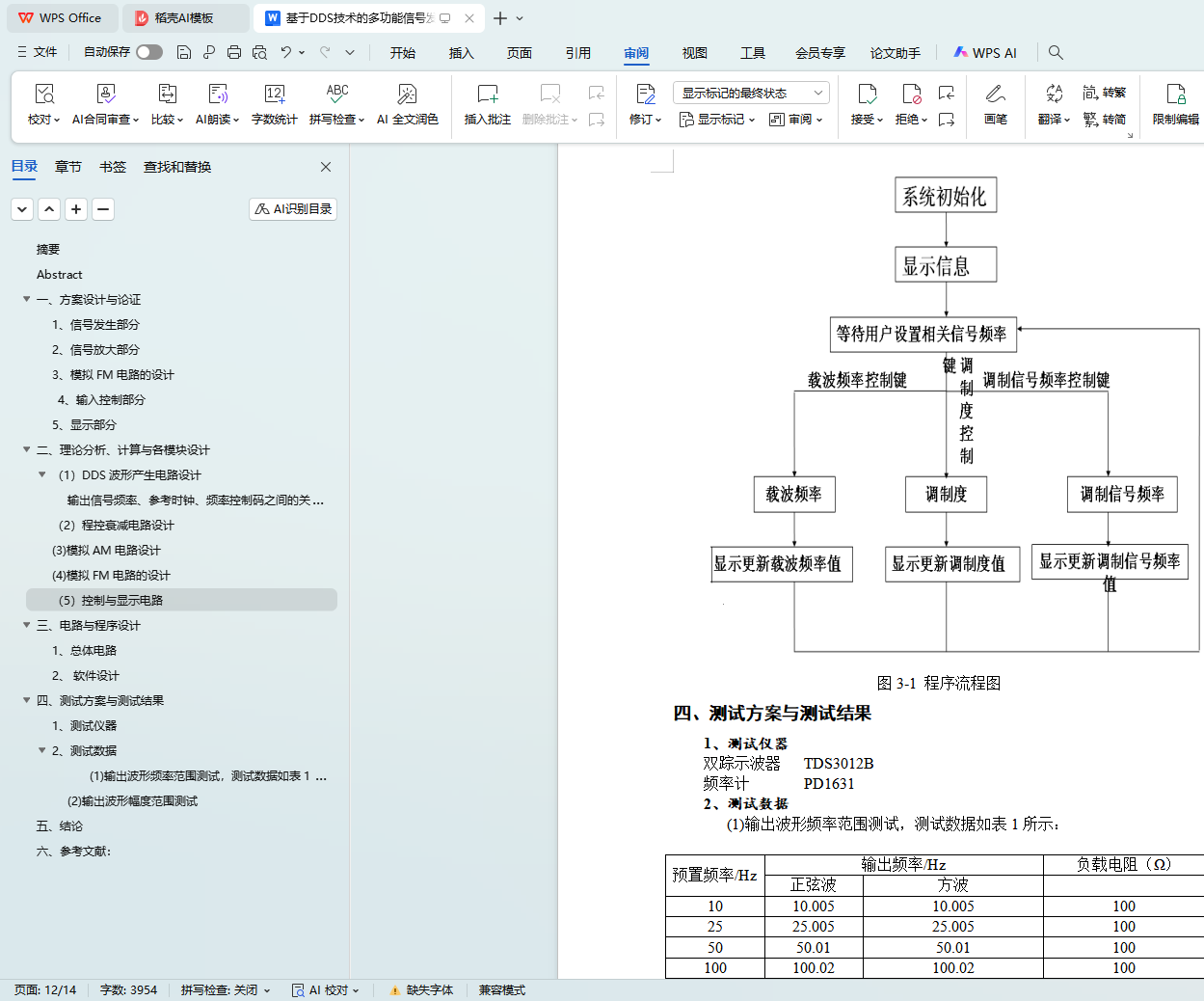
2、 软件设计
四、测试方案与测试结果
1、测试仪器
2、测试数据
(1)输出波形频率范围测试,测试数据如表1所示:
(2)输出波形幅度范围测试
五、结论
六、参考文献: