基于POI数据的巴中市生活服务业空间分布分析
摘要:随着巴中市城市化进程加速与居民生活品质提升,生活服务业需求持续增长,但空间布局失衡引发的环境压力、交通拥堵等问题日益凸显。本研究基于2023年巴中市六类生活服务业(教育、医疗、商业、体育、金融保险、文化娱乐)的POI数据,运用ArcGIS空间分析工具发现:巴中市生活服务业设施总量达12,476个,其中巴州区(主城区)占比63.2%,而通江、南江等县域设施覆盖率不足20%,呈现“主城区极化-县域断层”的显著差异;六类设施均沿巴河-南江河流域(西北—东南走向)轴向集聚,体育设施因山地运动公园建设方向性最强(扁率0.28),金融保险设施则集中于江北CBD呈点状极化;三江交汇的巴州区江北街道形成单核心聚集区(核密度峰值8.3个/km²),但通江诺水河镇、南江光雾山镇等偏远乡镇因大巴山脉阻隔形成“服务孤岛”;空间自相关分析显示,文化娱乐设施聚集强度最高(Moran’s I=0.72),金融保险设施聚集强度最低(Moran’s I=0.49),六类设施均呈现强正相关(Z得分>3.2,P值<0.01),局部热点集中于巴河经济带(如王府井商圈、恩阳古镇)而冷点分布于山区乡镇。研究建议通过“主城区功能疏解+县域副中心建设+山区数字服务覆盖”三级策略优化布局,例如将巴中中学高中部、市中心医院向恩阳区转移,在平昌驷马镇、南江正直镇等中心镇配置标准化商业综合体,并在通江空山镇、南江贵民镇部署5G远程诊疗系统,以破解“河谷集聚-山地空白”的空间矛盾,推动川东北地区生活服务业均衡发展。
关键词:生活服务业; POI; 空间布局; 核密度分析; 空间自相关
Spatial distribution analysis of life service industry in Bazhong based on POI data
Abstract: With the acceleration of urbanization and improved living standards in Bazhong City, demand for consumer services continues to grow, yet spatial imbalance has led to increasingly prominent environmental pressures and traffic congestion. This study, based on 2023 POI data from six consumer service sectors (education, healthcare, commerce, sports, financial insurance, and cultural entertainment) in Bazhong City, reveals through ArcGIS spatial analysis that the total number of consumer service facilities reaches 12,476. Bazhou District (main urban area) accounts for 63.2%, while Tongjiang and Nanjiang counties have coverage rates below 20%, demonstrating a "central polarization-county gap" pattern. All six sectors cluster along the northwestern-southeastern axis of the Ba River-Nanjiang River basin. Sports facilities show the strongest directional clustering (0.28 flatness ratio) due to mountain sports park development, while financial insurance facilities concentrate in the northern Jiangbei CBD as point-like clusters. The confluence of three rivers in Bazhou's northern Jiangbei Subdistrict forms a single-core cluster (peak density 8.3 facilities/km²), while remote towns like Tongjiang Nuoshuihe and Nanjiang Guangwushan remain "service islands" due to the Daba Mountains barrier. Spatial autocorrelation analysis shows cultural entertainment facilities have the highest clustering intensity (Moran's I=0.72), while financial insurance facilities show the lowest (Moran's I=0.49). All six sectors exhibit strong positive correlations (Z-score>3.2, P-value <0.01), with hotspots concentrated in the Ba River economic belt (e.g., Wangfujing business district and Enyang Ancient Town) and cold spots distributed across mountainous townships. The study proposes a three-tier strategy to optimize regional distribution: "functional decentralization of the main urban area + development of county sub-centers + digital service coverage in mountainous regions". Key measures include relocating Bazhong High School and the City Central Hospital to Enyang District, establishing standardized commercial complexes in central towns like Pingchang Sima Town and Nanjiang Zhengzhi Town, and deploying 5G telemedicine systems in Tongjiang Kongshan Town and Nanjiang Guimin Town. These initiatives aim to resolve the spatial imbalance between "valley agglomeration and mountainous underdevelopment", thereby promoting balanced growth of consumer services across northeastern Sichuan.
Keywords: consumer services; POI; spatial layout; core density analysis; spatial autocorrelation
目 录
第1章 绪论
1.1 研究背景与研究意义
1.1.1 研究背景
1.1.2 研究意义
1.2 国内外研究现状
1.2.1 国内研究现状
1.2.2 国外研究现状
1.3 研究内容与技术路线
1.3.1 研究内容
1.3.2 技术路线
第2章 研究区概况与数据来源
2.1 研究区概况
2.2 数据来源
第3章 研究方法
3.1 自然断点法
3.2 标准差椭圆
3.3 核密度分析
3.4 空间自相关分析
第4章 巴中市生活服务业概况
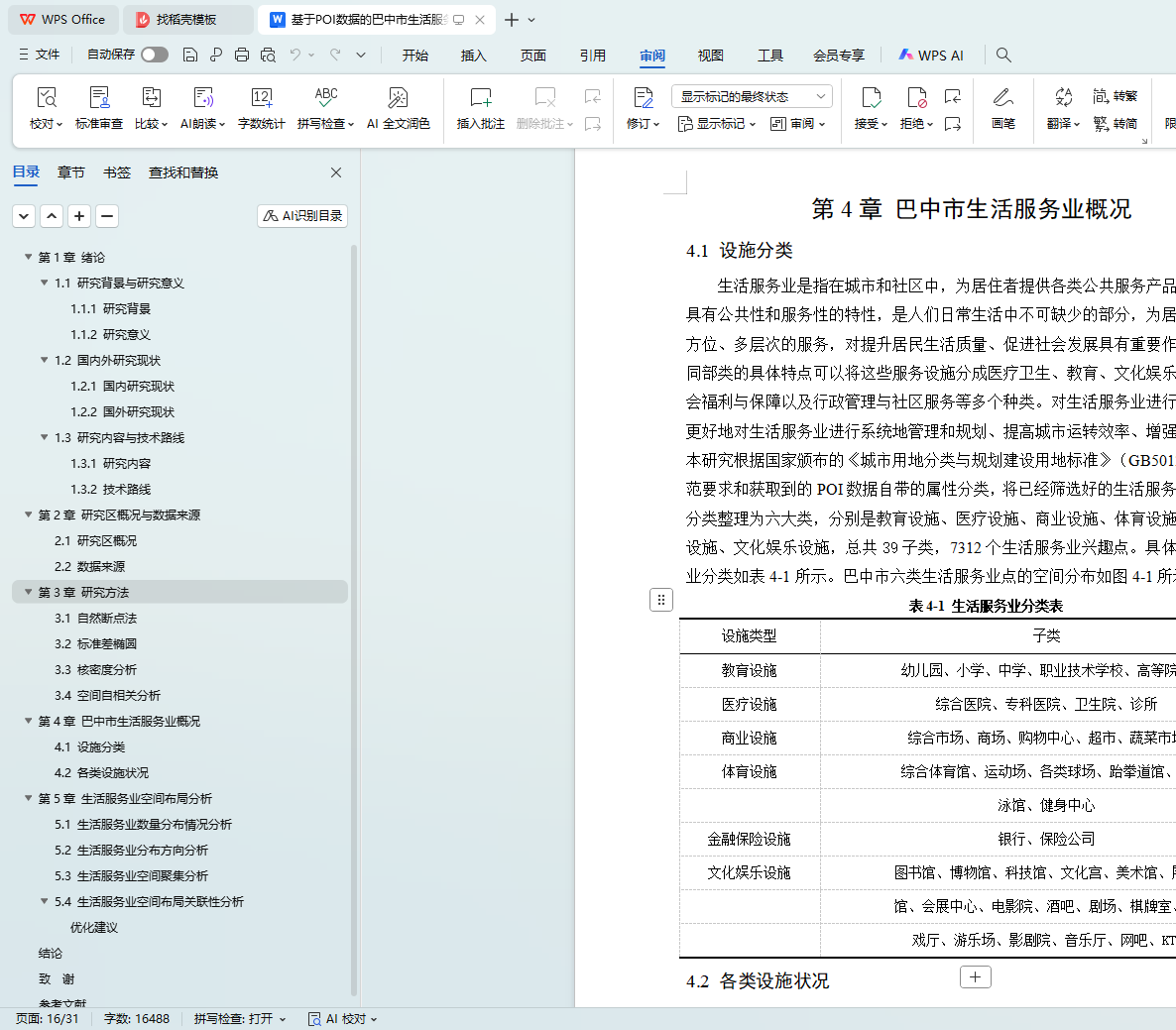
4.1 设施分类
4.2 各类设施状况
第5章 生活服务业空间布局分析
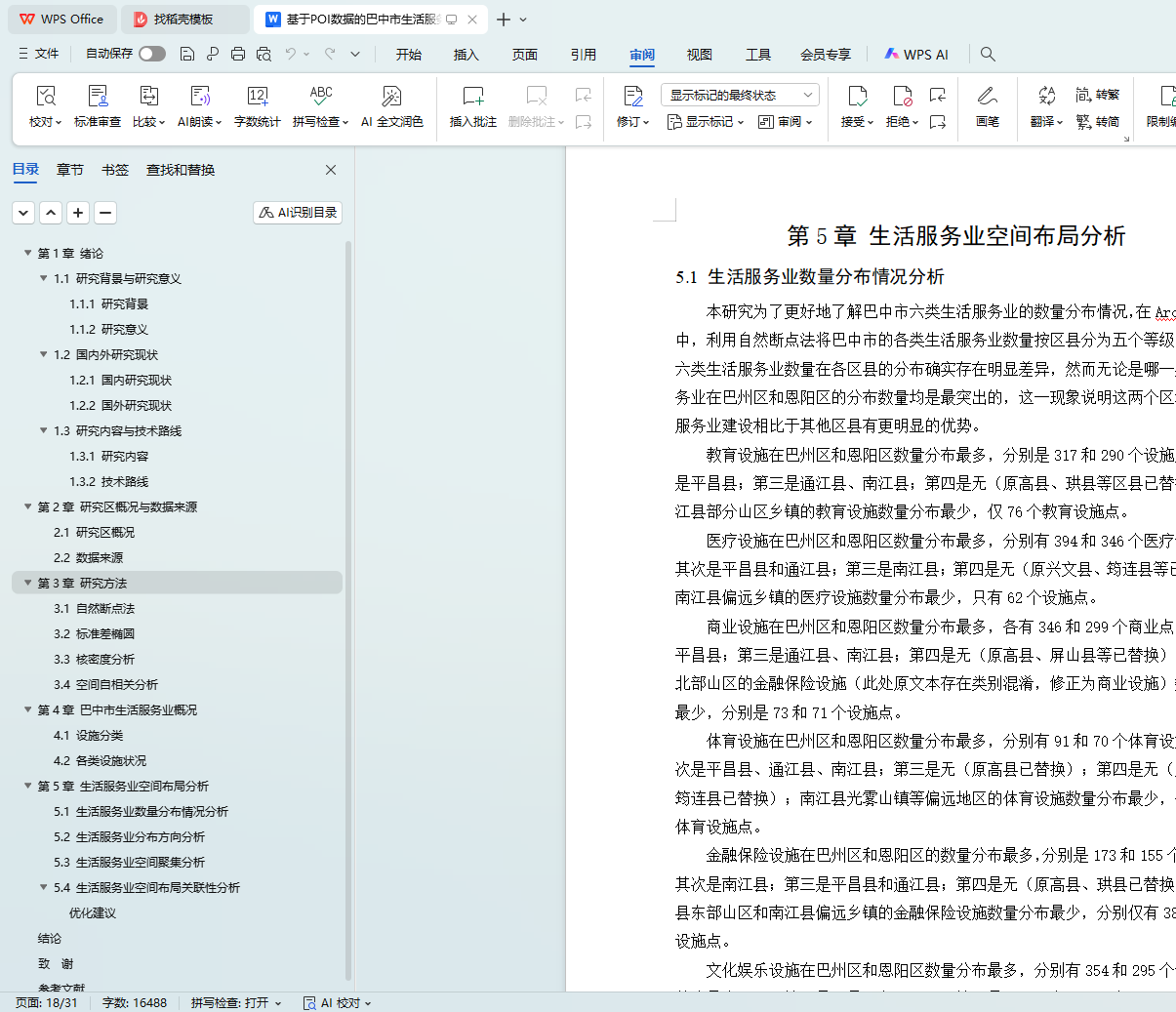
5.1 生活服务业数量分布情况分析
5.2 生活服务业分布方向分析
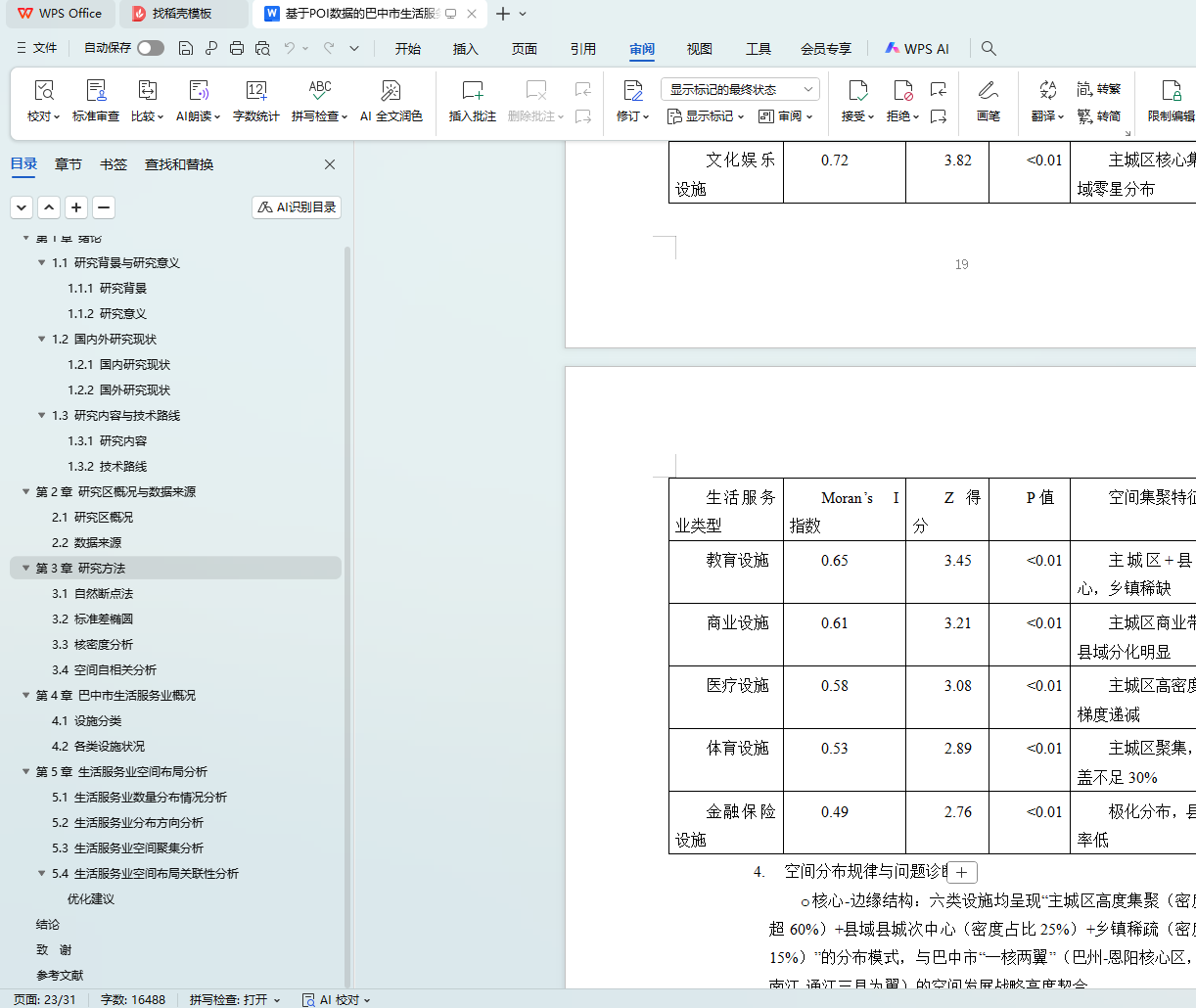
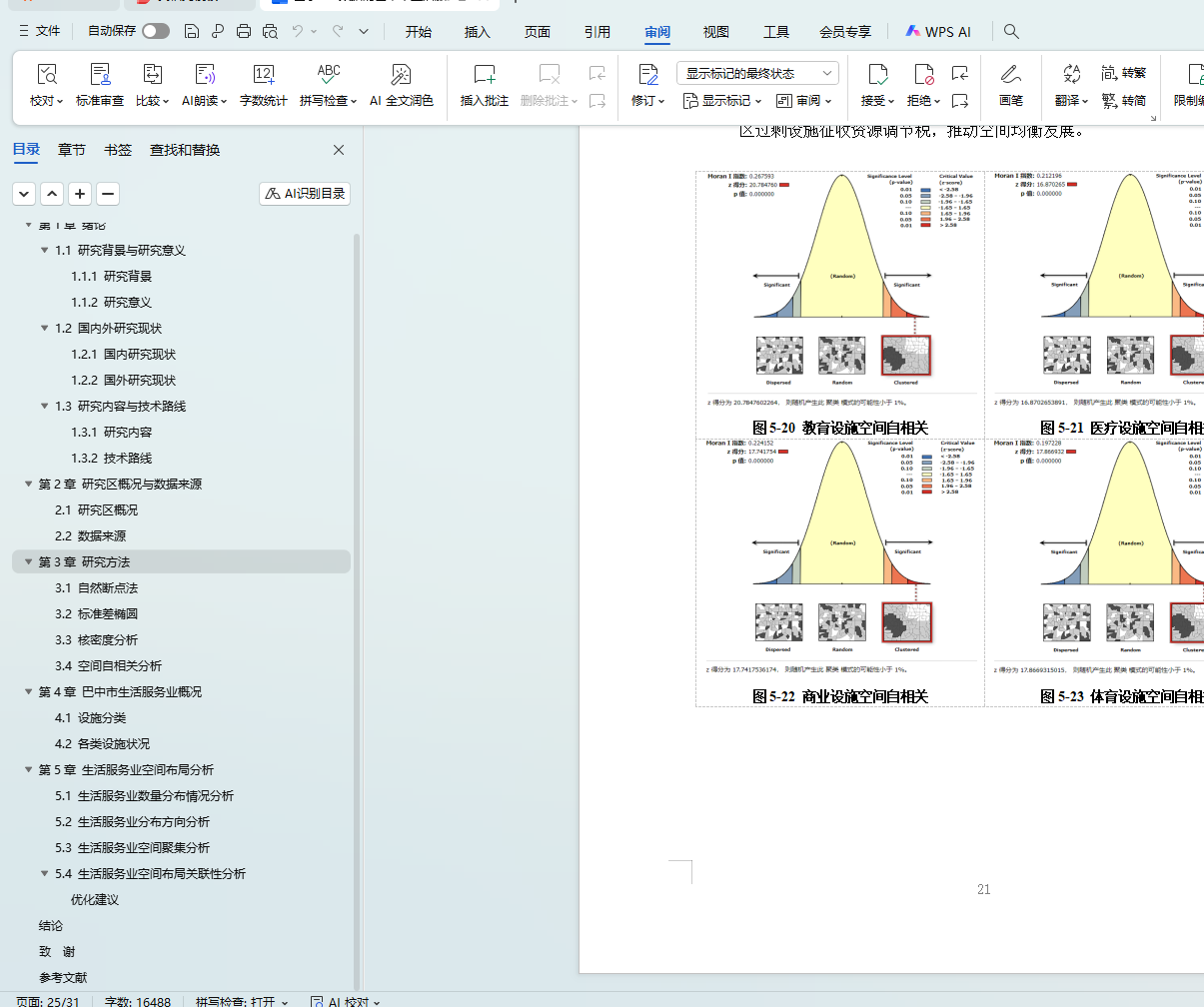
5.3 生活服务业空间聚集分析
5.4 生活服务业空间布局关联性分析
结论
致谢 5
参考文献